
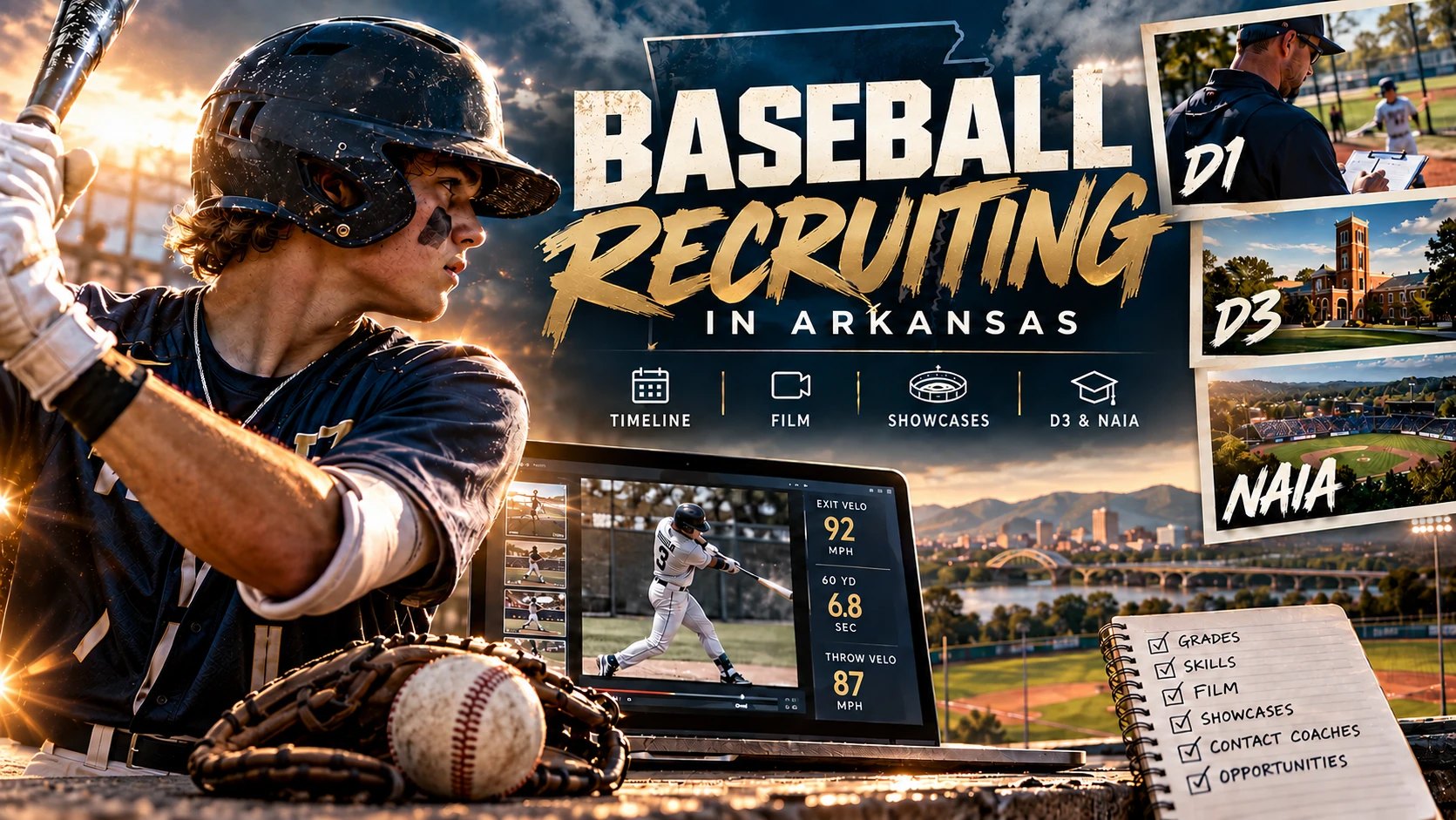
Most baseball recruiting content online is written for the kid hoping to play SEC ball — and that leaves most Arkansas families without a roadmap that actually fits their player. The truth is, the vast majority of high school baseball players who go on to play in college do it at the D2, D3, NAIA, and juco levels — not D1. This guide is written for that much larger, much more reachable path, alongside everything that applies regardless of level.
The level most families skip past
D3 and NAIA deserve a real look
D3 programs can't offer athletic scholarships under NCAA rules, but they stack academic aid, and rosters are often built around players who genuinely wanted to be there — real development, real playing time. NAIA programs, on the other hand, can offer athletic scholarships, often generously, and combine that with academic aid in ways that produce some of the best overall value in college baseball. A player who'd sit the bench at a D1 program frequently starts, plays four years, and graduates with far less debt at one of these schools. That's not a consolation path — for most families, it's the smarter one.
This matters in Arkansas specifically because the in-state options at these levels are strong: UCA, Harding, Henderson State, Ouachita Baptist, Arkansas Tech, Southern Arkansas, and Lyon College all field competitive baseball programs actively recruiting Arkansas high schoolers. A realistic target list should include several of these from day one, not as a backup plan but as the plan.
The recruiting timeline, freshman to senior
Freshman year — Build the foundation
- Focus on fundamentals and physical development — freshman year is about growth, not results
- Start a film library now, even informally — a couple of games or scrimmages a season builds a baseline
- Get an initial read on travel ball options; a good program provides both development and exposure
- Establish study habits early — GPA is cumulative from this point forward
Sophomore year — Start showing up
- Attend a showcase or two to get comfortable with measured, verified performance (velocity, exit velo, 60-yard time)
- Build a Prep Baseball Report or Perfect Game profile if travel ball participation supports it
- Film meaningfully this season — this becomes the "before" footage that shows development later
- Begin a realistic target school list across levels: D1 reach, D2/NAIA realistic, D3 academic-fit options
Junior year — The heavy year
- This is when coach contact typically opens up meaningfully — direct outreach starts here
- Produce a real recruiting reel from junior film — position-specific, verified measurables included
- Attend camps at target schools where coaches can evaluate in person, not just on film
- Register with the NCAA or NAIA eligibility center depending on the target level
Senior year — Close it out
- Update film after every strong outing and send it to coaches who've shown interest
- Take official visits and finalize applications and financial aid paperwork
- Stay open into spring — D2, D3, NAIA, and juco rosters often fill later than families expect
What baseball recruiting film needs to show
Baseball is more position-specific than almost any other recruiting sport — a generic highlight reel undersells what coaches actually need to see.
Hitters
Full at-bats, not just contact. Coaches want to see the stance, load, timing, and approach — including the pitches taken, not only the ones hit. A reel of only highlight-reel hits with no context reads as cherry-picked, because it is. Exit velocity, measured at a showcase or with a radar tool, is one of the most requested numbers in the entire recruiting process.
Pitchers
The complete delivery from a clean angle — usually center field or a side angle that shows the full mechanics, not a tight shot on the release point alone. Include multiple pitch types if available, and velocity readings are close to essential; a pitcher's film without a velocity number attached gets far less attention than one with it.
Infielders
First-step quickness, footwork through the transfer, and arm strength on the throw — a clean angle that shows the whole sequence from read to release matters more than a highlight-only clip of the diving catch. Pop time (for catchers) and infield velocity are the measurables coaches ask for.
Outfielders
Range and route efficiency to the ball, plus arm strength on the throw back in. Wide framing matters enormously here — a tight shot that only catches the catch itself misses the route-running that's actually being evaluated.
Showcases and travel ball
Travel ball and showcase events are where a large share of baseball recruiting exposure happens, arguably more than in any other sport covered in this series. A few practical notes: showcases that provide measured data (radar readings, timed sprints) carry more weight than ones that don't, because coaches trust a number verified on-site over a number reported by a parent. Regional showcases within driving distance of Arkansas are usually a better first step than a marquee national event — get comfortable with the format and the measuring process before investing in the biggest stage.
Whatever showcases your family chooses, bring a way to capture the swings, the innings pitched, or the defensive reps — that footage becomes part of the season's film library even when the primary purpose of the day was the measured numbers.
Building the library
The pattern across every level of baseball recruiting is the same one from our full Arkansas recruiting guide: film is how a coach who can't be at every game still evaluates a player. Building that library game by game, season by season, from freshman year onward means the junior-year reel — the one that matters most — is built from years of accumulated film, not scrambled together in a few weeks.
If a season of games or showcase footage is already sitting unedited, Clip-to-Reel turns it into a position-specific reel starting at $99, available nationwide — no re-filming, no waiting for next season.
Give this season the film it deserves.
Season Recruiting: 6 full games filmed, a recruiting reel each game, and a final college-ready film — unlimited raw footage, Hudl and NCSA delivery included. $1,299.
Is D3 or NAIA baseball a good option for Arkansas players?
Yes, and these levels are often overlooked. D3 and NAIA programs offer real playing time, strong academics, and — for NAIA specifically — athletic scholarship money that D3 cannot offer under NCAA rules. Many Arkansas players who wouldn't see the field at a D1 program play four meaningful years at a D3 or NAIA school.
When should a baseball player start the recruiting process?
Freshman year is the right time to start building the foundation — skill development, a growing film library, and initial exposure to travel ball and showcases. Junior year is typically the heaviest recruiting year, when direct coach contact and a strong highlight reel matter most, so waiting until senior year means starting after many rosters are already largely set.
What should be in a baseball recruiting video?
Position-specific footage that shows mechanics clearly: full at-bats for hitters (not just contact), complete pitching motions for pitchers, and fielding sequences that show first-step quickness and arm strength for position players. Verified measurables — exit velocity, 60-yard time, pop time, velocity — carry significant weight alongside game film.